Loading…
Pick the format that suits the room you have and the part of you that you want the light on. If it's only your face and you'd like something you can use sitting on the sofa, a mask is the simple choice. If you want light on your face and other areas, or you don't like the idea of something resting on your face, a panel suits you better. A compact panel is easier to store and move. A full-size panel lights more of you at once but needs a proper home. A set only makes sense if you'd use both pieces.
That's the short version of how to choose between a red light panel and an LED mask. The rest is the detail we'd want before spending the money.
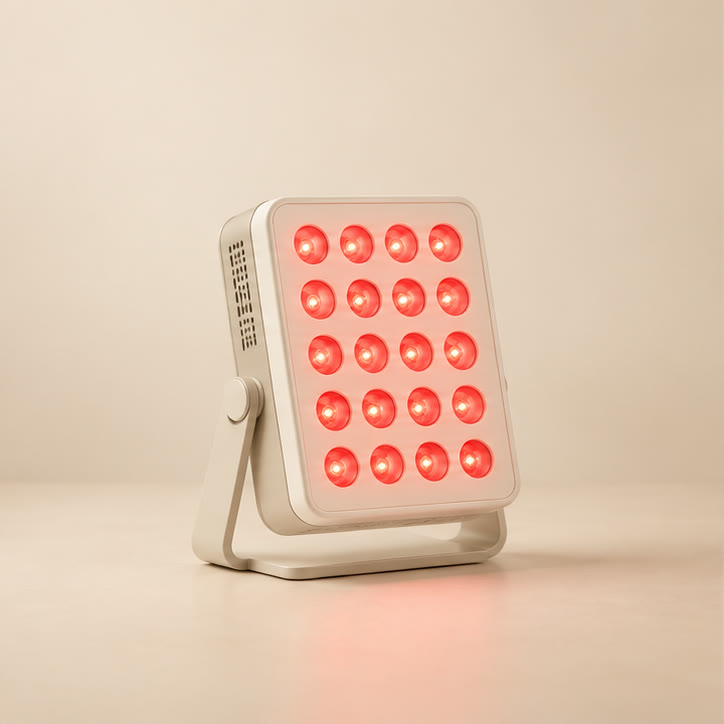
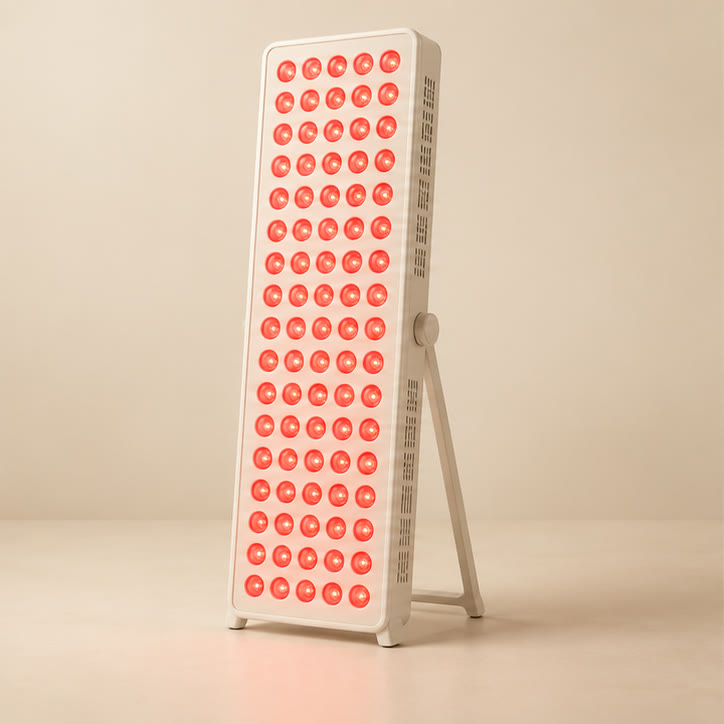
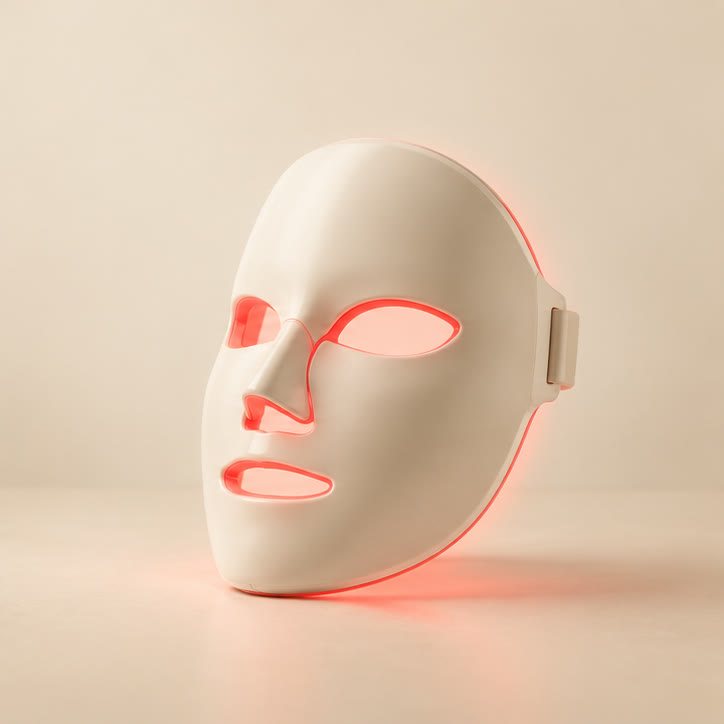
We sell all four options, so here they are with prices. The Ritual Mini is our compact panel at £249. The Ritual Panel is the full-size panel at £599. The Ritual Mask is an LED face mask at £199. The Starter Ritual pairs the Mini with the Mask for £429, and The Full Ritual pairs the Panel with the Mask for £759. Our specifications aren't confirmed yet, so we can't give you dimensions, weights or what comes in the box. We'll say so wherever it matters below.
A compact panel is a smaller flat light you stand on a surface or fix in place, then sit in front of. It covers a smaller area, so you'd usually point it at one part of you at a time. It's the one you can put away in a cupboard and bring out again without much fuss.
A full-size panel works the same way but is bigger. More of you sits in front of the light at once, which is the point of buying one. The trade-off is that it's harder to tuck away, and most people end up giving it a fixed spot.
An LED face mask is a wearable. It rests on or close to your face, so the distance between light and skin is set by the design, not by where you sit. It covers the face and nothing else.
A set is simply two of these bought together. Ours pair a panel with a mask, so you'd have a face device and a device for anywhere else.
The usual regret with a home device has nothing to do with the light. It didn't fit where the buyer imagined, so it lived in the box.
So before you look at any product page, pick the actual spot. Not "the bedroom", but the bit of floor beside the wardrobe, or the shelf above the radiator. Then measure it with a tape: width, depth and height, plus a bit of clearance around the sides. Write it down.
Next, look for the nearest socket. A device that needs an extension lead trailing across the landing isn't going to get used much, and a lead across a walkway is a trip hazard. Note how far the socket is and whether it's already crowded with a phone charger and a lamp.
Then think about who else uses the room. A panel in a shared bedroom has to suit both of you, including the light. A mask in a house with small children or a curious dog needs a drawer or a shelf, not the arm of the sofa.
Finally, decide whether the device will live out or be put away after each use. That one decision does more to narrow the choice than anything on a spec sheet. If it has to go back in a cupboard every time, a mask or a compact panel is far more realistic than a full-size one.
A panel needs three things: a stable place to sit or hang, room for you at the distance the manufacturer tells you to use, and a socket within reach.
That middle one catches people out. Panels are designed to be used at a particular distance, and the light reaching you changes as you move closer or further away. So the space you need isn't the size of the panel. It's the panel, plus the gap, plus you sitting or standing in front of it. Check what distance the instructions give, then mark it out on the floor with a bit of tape before you order.
Next, check how it's held in place. Some panels stand on a surface, some come with a floor stand, some hang from a door or mount on a wall, and some need an accessory that's sold separately. Look at the manufacturer's documentation rather than the photographs, because a lifestyle photo might show a stand that isn't in the box. If it's going on a wall, find out what fixings it needs and whether your wall will take them. A stud wall and a brick wall are different jobs.
Our guide to reading device specifications goes through what to look for in the documentation, including the measurement distance behind any output figure.
A mask removes most of the placement problem. You don't need a wall, a stand or a gap to measure. You need a socket or a charged battery, somewhere to sit or lie back, and somewhere clean to keep it afterwards.
What it asks for instead is fit. Masks are held on in different ways: straps, a band around the head, or a shell you hold in place. Faces aren't all the same shape, and some designs press on the bridge of the nose or the ears. If you wear glasses, you'll be taking them off for each session, so think about whether that matters to you.
Eyes are a bigger question with a mask, because the light sits right in front of them. The manufacturer's instructions should tell you whether to close your eyes, whether shields or goggles come with it, and who shouldn't use it. Our page on red light therapy and your eyes covers that properly, and our LED face mask UK buying guide has the full checklist for buying one.
Cleaning matters more with a mask too, simply because it touches skin and sits near your mouth and nose. Check what the manufacturer says to clean it with before you buy, and decide where you'll store it so it stays clean between uses.
This is where the formats really split.
A mask is a face device. If the face is all you're interested in, a mask is the most direct way to get light there without worrying about distance. Masks have been studied as masks, too. Park and colleagues (2025) ran a sham-controlled trial of a home-use mask in 60 adults, and the 2026 systematic review by Das and colleagues looked specifically at at-home face devices, finding eight studies with 365 participants in total. We cover what those studies found in our red light therapy for skin guide, so we won't repeat it here.
A panel lights whatever you put in front of it. That might be your face one day and your neck, chest, hands or back another. Research has used large-area sources as well as masks. The 2014 trial by Wunsch and Matuschka, for example, tested light sources designed for large-area and full-body use.
What neither body of research shows is that one format gives a better result than the other. They're different ways of getting light to different places. Choose by where you want it, not by which sounds more powerful.
A format that suits your day will get used. One that needs a ten-minute setup won't, however good it looks.
A mask is close to hands-free once it's on. You can sit or lie back while it's on, and listen to something while you wait.
A panel needs you to be in a particular spot, facing a particular way, for the length of the session. That's fine if the panel lives somewhere you already spend a few minutes, like the corner of a bedroom where you get dressed. It's harder if you have to set it up from scratch each time.
A compact panel sits between the two. It's easier to move from a bedside table to a desk, and easier to put away, but you still need to sit in front of it.
If you share a home and both want to use a device, a panel is often easier to share than a mask, because nobody is wearing it. Both still need cleaning between people, and both of you should read the instructions yourselves.
Our guide to planning a routine you'll keep goes further into fitting sessions into a normal week.
If you've decided on a panel, the next choice is size.
The honest way to compare is the illuminated area at the distance you'll use it. A bigger panel lights a bigger patch of you at that distance. A smaller one lights less, so you might use it on one area per session. Ask any seller for that figure. Jenkins and Carroll (2011), writing about how light studies should be reported, list beam area at the skin among the eight most important parameters and point out that it isn't necessarily the same as the size of the opening the light comes from. In other words, the panel's outside dimensions don't tell you how much of you it lights.
Beyond that, the decision is practical. Choose a compact panel if you're short on space, need to put it away after each use, want to move it between rooms, or mainly want light on one area at a time. Choose a full-size panel if you have a fixed spot for it, want more of you in front of the light at once, and don't mind a larger object in the room.
In our range, that's the Ritual Mini at £249 or the Ritual Panel at £599. Their specifications aren't confirmed, so we can't yet tell you the illuminated area for either. When we can, it'll be on the product pages with the distance it was measured at.
A set is for someone who wants a mask for the face and a panel for everything else.
The Starter Ritual is the Ritual Mini and the Ritual Mask together for £429. Bought separately they'd cost £448, so the set saves £19. The Full Ritual is the Ritual Panel and the Ritual Mask together for £759. Separately they'd be £798, so it saves £39.
That's the whole case for a set: a modest saving if you'd buy both anyway. It isn't a reason to buy a second device you won't use. We're not aware of any evidence that using a panel and a mask together gives a better result than using one, and we won't suggest otherwise.
Think about space twice if you're buying a set. You need a home for a panel and a home for a mask, which might be in different rooms.
One practical note on returns. Under regulation 30 of the Consumer Contracts Regulations 2013, if a multi-item order arrives on different days, the cancellation period ends 14 days after the last item comes into your possession. That gives you time to set up both pieces before deciding.
Whatever format you choose, the most common surprise is what's missing. A photo can show a floor stand, a wall bracket, goggles, a carry case or a controller that is actually an optional extra.
Before you pay, ask for the actual box contents in writing, or find them in the manufacturer's documentation. Things worth checking: how the device is held in place, whether a plug or adaptor is included for UK sockets, whether eye protection comes with it, and whether there's a timer or controller.
The law is on your side here. Section 11 of the Consumer Rights Act 2015 says a contract to supply goods by description is treated as including a term that the goods will match the description. If a listing says a stand is included, it should arrive.
Our own box contents aren't confirmed yet, so we can't list them. They'll be on each product page before we take orders for that product.
Changing the shape of a device doesn't change the questions you should ask about the light.
For any format, ask whether it has been assessed against IEC 62471. That's the international standard for the photobiological safety of lamps and lamp systems, and its scope covers LEDs across the wavelength range from 200 to 3,000 nm. Ask what the manual says about eyes, about who shouldn't use the device, and about how to clean it. And check the product marking. Our specification guide explains what each of those documents does and doesn't tell you.
Go through these honestly and the answer usually falls out.
If you only care about your face and want something to use sitting down, look at a mask.
If you have a corner you can give over permanently and you'd like light on more than your face, look at a full-size panel.
If space is tight, you need to put things away, or you want to try a panel without committing a corner of the room, look at a compact panel.
If you're sure you want a face device and a panel, and you have room for both, look at a set.
And if you can't picture where it would go, don't buy anything yet. Measure first.
This guide is about choosing a shape that fits your home. It isn't a guide to treating anything. If you have a skin condition, an eye condition, a condition triggered by light, or you take a medicine that makes you sensitive to light, speak to a GP or pharmacist before buying any light device. Our page on side effects has more on who should check first.
It's also not for anyone hoping a bigger or more expensive format will give a bigger result. The research doesn't show that, and we won't claim it.
We'd pick the spot before the product. We'd measure it, find the socket, and decide whether the device lives out or goes away after use. Then we'd choose the format that fits that spot and the areas we actually want to use it on, and check the box contents and the safety documentation before paying.
If that points to a compact panel, the Ritual Mini is £249. If it points to the face, the Ritual Mask is £199. Delivery is free and tracked on orders over £100, and every order carries a 14-day right to cancel, so you can check the fit in your home before you decide to keep it.
Neither is better in general. They are different shapes for different places. A mask sits on the face and only covers the face. A panel sits apart from you and can face whichever area you turn towards it. The 2026 systematic review by Das and colleagues looked only at at-home face devices, so there is no fair head-to-head result to point to.
It depends on the panel, so check the dimensions, weight and stand or mounting options in the manufacturer's documentation, plus the distance it tells you to sit or stand from it. You need room for the device, for you at that distance, and for the cable to reach a socket without stretching across a walkway.
A compact panel is easier to store and move between rooms. A full-size panel lights a bigger area at once. Ask any seller for the illuminated area at the stated distance, because that is what tells you how much of you sits in front of the light. Our Ritual Mini is £249 and the Ritual Panel is £599.
Only if you would use both. The Starter Ritual (Ritual Mini and Ritual Mask) is £429, which saves £19, and The Full Ritual (Ritual Panel and Ritual Mask) is £759, which saves £39. There is no evidence that two devices work better than one.
Usually, yes. Under the Consumer Contracts Regulations 2013, the cancellation period for most online goods ends 14 days after the day they come into your physical possession, and for a multi-item order delivered on different days, 14 days after the last item arrives. Our orders carry the UK and EU 14-day right to cancel.
An LED face mask UK buying guide: the claims that break UK rules, markings to look for, what mask trials found, eye safety and your right to cancel.
How to read a red light therapy spec sheet: wavelength, irradiance and its distance, beam angle, flicker, EMF claims, IEC 62471, UKCA or CE and warranty.
Plan a red light therapy routine you will keep: where the device lives, time of day, following the instructions, eyes, cleaning and when to ask a GP.
Red light therapy and your eyes: what the safety standard covers, what the eye research found, whether to close your eyes, and who should ask first.