Loading…
Read it in this order. First, wavelength, in nanometres, with the share of LEDs at each one. Second, irradiance, in mW/cm², with the distance it was measured at and how it was measured. Third, the illuminated area and beam angle at that distance. Then flicker, any EMF claim, the photobiological safety assessment (look for IEC 62471), the product marking, the warranty and what's in the box. A number without its measurement conditions tells you very little, and a sheet that won't give conditions is telling you something too.
That's the answer to how to read a red light therapy specification sheet in one paragraph. Below, we take each line in turn and explain what it means, what a good version looks like, and what we'd ask if it's missing.
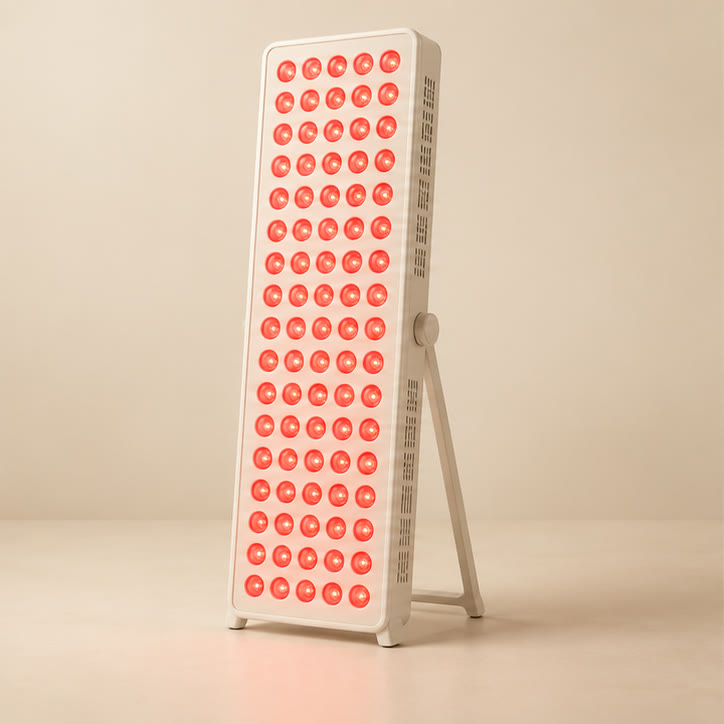
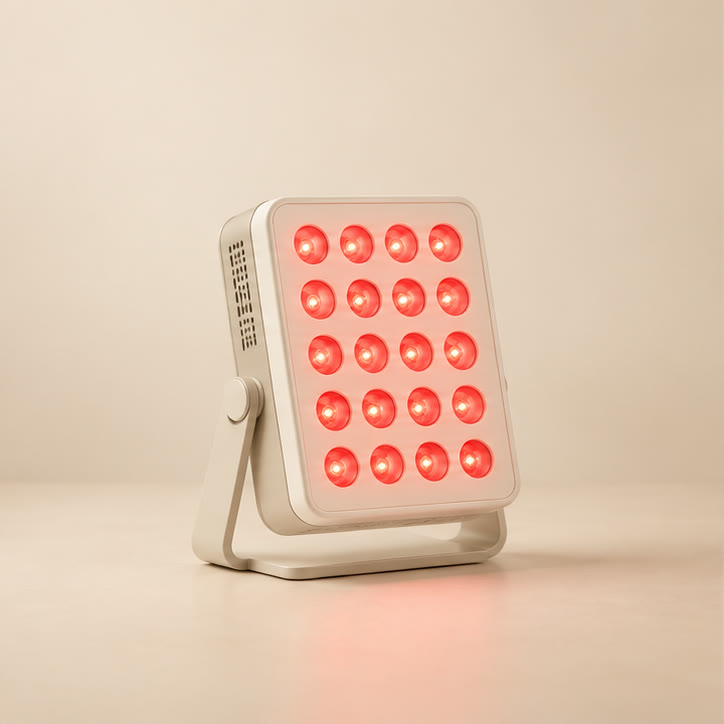
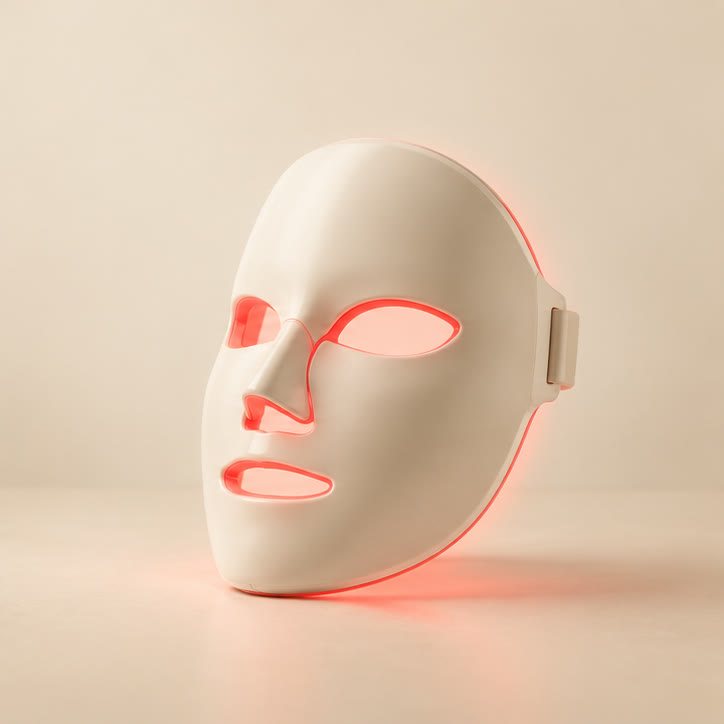
A word about our own range first. The Ritual Panel is £599, the Ritual Mini is £249 and the Ritual Mask is £199. None of their specifications is confirmed yet, so there's nothing for you to check on our product pages today. Use this guide on any device you're looking at, and use it on ours when the sheets go up.
Light devices are sold on numbers, and the numbers are easy to print and hard to check.
Researchers have the same problem. Jenkins and Carroll (2011), writing a reference for people running light studies, said journals frequently publish studies with missing data, mathematical errors and no reported verification of beam parameters. If trials struggle to report this properly, a product listing written by a marketing team is going to need a careful read.
Their checklist is a useful yardstick for buyers too. They list eight beam parameters that matter most: wavelength, power, irradiation time, beam area at the skin, pulse parameters, anatomical location, number of treatments and the interval between treatments. A good spec sheet and a good manual between them should cover most of that list.
Wavelength is given in nanometres (nm) and describes the colour of light the LEDs are designed to emit. Red light sits in the visible range and near-infrared beyond it. Our page on red light vs near infrared explains the difference and what the trials compared, so we'll stick to how it appears on a sheet.
What a good version looks like: each wavelength listed, with the proportion of LEDs at each one, and ideally a measured spectrum rather than just the nominal LED rating. Some research devices report a tolerance. Bragato and colleagues (2025) described their mask as 660 ± 10 nm, which tells you the spread around the headline number.
What to be wary of: a long list of wavelengths with no proportions. Five wavelengths sounds like more than two, but if most of the LEDs are one colour, the list tells you little about the light you'll get.
Wavelength on its own doesn't describe how much light reaches you. For that you need the next line.
Irradiance is the power of light arriving on a given area, usually written as milliwatts per square centimetre (mW/cm²). It's the single most useful output figure on a sheet, and the one most often given without what you need to make sense of it.
The distance matters most. Light from a panel spreads out, so the amount arriving on your skin changes as you move closer or further away. A figure measured with the meter pressed against the LEDs will look much bigger than one measured at the distance you'll actually use. Neither is wrong, but you can't compare them. Look for the distance printed next to the number, and check it matches the distance in the instructions.
Then look for how it was measured. Which meter, whether it was calibrated for these wavelengths, and whether the figure is a single reading at the centre of the panel or an average over an area. Those two can be quite different.
Units matter more than people think. Irradiance is power per area, so it should be per square centimetre. Even published research can slip. The abstract of the 2025 mask trial by Park and colleagues gives the output as a maximum of 10 mW per cubic centimetre, which isn't a unit of irradiance. That's not a criticism of the trial, which reported other things carefully, but it shows how easily a unit goes wrong in print. If a sheet's units look odd, ask.
Devices change over time, too. Jenkins and Carroll note that beam power often drops as a device warms up and as it ages. A figure measured on a brand-new unit in its first minute is a best case.
Some sheets give a dose, also called energy density or fluence, in joules per square centimetre (J/cm²). It's irradiance multiplied by time.
Bragato and colleagues (2025) reported theirs fully: 6.4 mW/cm² for 21 minutes, giving 8.05 J/cm². You can check that yourself. Twenty-one minutes is 1,260 seconds, and 6.4 thousandths of a watt for 1,260 seconds is just over 8 joules per square centimetre. When a sheet's numbers add up like that, it's a good sign someone measured them.
A dose figure is only as good as the irradiance and distance behind it. And a bigger dose isn't automatically better. Our near-infrared guide explains why the research describes a dose response where more light doesn't keep helping.
These trial figures describe their devices under study conditions. They aren't a target to shop for, and they say nothing about our devices.
Each LED throws light in a cone, and the beam angle tells you how wide. A narrow angle concentrates light in a smaller patch. A wide angle spreads it over more of you, at a lower level. Neither is better in itself. It depends on how far away you'll be and how much of you you want lit.
The more useful figure is the illuminated area at the working distance, ideally with a note of how even the light is across it. That tells you whether your whole face, or your face and neck, sits in the light at the distance the instructions give. As we said in our guide to choosing a format, the panel's outside size isn't the same thing.
You'll sometimes see claims that a wider beam goes deeper. Ash and colleagues (2017) modelled this in simulated skin. They calculated that a 10 mm beam produced 73 to 88% of the fluence at depths of 1 to 3 mm compared with an infinitely wide beam of the same incident fluence, and concluded that little additional penetration is achieved with larger spot sizes. That's a computer model of how light travels, not a result for any product, but it's a reason to be sceptical of depth claims built on beam size.
LED light isn't always perfectly steady. Depending on how the LEDs are driven, the output can rise and fall many times a second, which researchers call temporal light modulation. You may not see it at all.
A 2026 review by Brodaczewski and Brodaczewski on LED flicker found the strongest evidence of harm concerns visible flicker in photosensitive epilepsy, notably in the 3 to 65 Hz range. It also noted that foundational research found continuous exposure to 100 Hz light can cause headaches and eyestrain even when the flicker can't be seen. The authors were careful to say the evidence suggests caution, not causality.
For a buyer, that means asking whether the device flickers, at what frequency, and how deep the modulation is. A sheet that says "flicker-free" should be able to say how that was measured. If you have epilepsy or a condition triggered by light, speak to your GP before using any light device.
"Low EMF" and "zero EMF" are common selling points on panels. The problem is that the claim usually comes with no number at all.
UKHSA's guidance on electromagnetic fields says advice is built on exposures complying with the guidelines from the International Commission on Non-Ionizing Radiation Protection (ICNIRP), and notes that public exposure is typically well below those guidelines. It also explains the units: electric fields in volts per metre, and magnetic fields usually in microtesla.
So a meaningful EMF claim gives a measured value in those units, the distance it was measured at, the method, and what it was compared with. Without that, "low EMF" is an adjective.
Don't confuse this with EMC. The Electromagnetic Compatibility Regulations 2016 require equipment not to generate disturbance above the level at which other equipment can't work as intended, and to be immune enough to normal disturbance. That's about your device not interfering with your Wi-Fi, and vice versa. It isn't a statement about exposure to your body.
This is the document we'd ask for first.
IEC 62471 is the international standard for the photobiological safety of lamps and lamp systems. According to the IEC, it sets exposure limits, a reference measurement technique and a classification scheme for the photobiological hazards of electrically powered incoherent sources, including LEDs but excluding lasers, across 200 to 3,000 nm.
What to ask for: the test report or a summary of it, which classification the device received, at what distance, and who did the testing. The instructions about eyes should follow from that assessment. Our page on red light therapy and your eyes goes into what that means in use.
A device that plugs into the mains will usually fall under the Electrical Equipment (Safety) Regulations 2016, which apply to equipment designed for a voltage rating between 50 and 1,000 V AC. Ask whether the declaration of conformity lists those regulations, alongside the EMC ones.
GOV.UK guidance says UKCA and CE markings show the manufacturer believes the product meets the relevant product requirements, and that the UK continues to recognise CE marking for many products in Great Britain. Ask to see the declaration and check which regulations it names.
A marking isn't proof that a device does anything for your skin. And if a seller makes medical claims, the device is in a different category. GOV.UK guidance on medical devices defines them by purposes including the treatment or alleviation of disease. Our LED face mask buying guide explains what that means for adverts.
The last section of a sheet is the one people skim, and it's often the one they need in month eight.
Read the warranty itself, not the headline. Section 30 of the Consumer Rights Act 2015 says a guarantee must set out its contents in plain and intelligible language, state that your statutory rights aren't affected, and give the name and address of the guarantor. Check what it covers (LEDs, controller, cable), who you claim from, and who pays postage.
Remember a warranty sits on top of your statutory rights. Section 9 of the same Act lists durability among the aspects of satisfactory quality. A manufacturer's warranty can add to that, but can't take it away.
Then the box. Ask for the contents in writing: stand or mount, cable and plug, controller or timer, eye protection, manual. A photo isn't a list.
If a sheet leaves gaps, these questions cover most of them. Send them by email so you have the answers in writing.
What wavelengths does the device emit, in what proportions, and do you have a measured spectrum?
What is the irradiance in mW/cm², at what distance, measured with what meter, and at the centre or averaged?
What area is lit at the working distance?
Does it flicker, and at what frequency?
Has it been assessed against IEC 62471, and which classification did it receive?
What marking does it carry, and can I see the declaration of conformity?
What does the warranty cover, and what's in the box?
A seller who answers all of that quickly and clearly has probably done the work.
This guide is for comparing devices on paper. It can't tell you whether any device suits your skin or your health. If you have an eye condition, epilepsy or a condition triggered by light, take a medicine that makes you sensitive to light, or are pregnant, speak to a GP or pharmacist before you get as far as a spec sheet.
It's also not much use if you want a single number that ranks devices. There isn't one.
We're holding our devices to this list. Today we have no confirmed specifications for the Ritual Mini, the Ritual Panel or the Ritual Mask, so we're not publishing wavelengths, irradiance, safety classifications or box contents. When they're confirmed, they'll go on the product pages with the measurement conditions alongside.
If you're comparing panels, the Ritual Panel is £599 and the Ritual Mini is £249. Please don't buy either until you can read a sheet for it that answers the questions above.
There isn't one right number, and a figure is meaningless without the distance it was measured at. Trials report their own settings. Bragato and colleagues (2025), for example, used a red mask at 6.4 mW/cm² for 21 minutes. Ask any seller for irradiance in mW/cm², the distance, and how it was measured.
Because the light reaching you changes as you move closer to or further from a panel. Two irradiance figures taken at different distances can't be compared directly. A trustworthy spec sheet gives the distance next to the number, and ideally the illuminated area at that distance.
IEC 62471 is the international standard for the photobiological safety of lamps and lamp systems. It sets exposure limits, a reference measurement technique and a classification scheme for hazards from sources including LEDs, from 200 to 3,000 nm. Ask for the test report and which classification the device received.
No. GOV.UK guidance says UKCA and CE markings show the manufacturer believes the product meets the relevant product requirements. That is a declaration about meeting product rules, such as electrical safety, not a test of any result on your skin.
On its own, not much. UKHSA advises that exposure to electric and magnetic fields should comply with the ICNIRP guidelines, and magnetic fields are usually measured in microtesla. A meaningful claim gives a measured value, the unit, the distance, the method and the reference it was compared against.
They are not confirmed yet, so we are not publishing any. When they are, we will list them on each product page with the measurement conditions, the safety assessment and what is in the box.
Red light vs near infrared light therapy explained: the wavelength ranges, how deep each reaches, what trials compared, and what we can't say yet.
An LED face mask UK buying guide: the claims that break UK rules, markings to look for, what mask trials found, eye safety and your right to cancel.
Red light panel or LED mask? How to choose a format by the space you have, where it will sit, the areas you want to cover and the routine you will keep.
Red light therapy and your eyes: what the safety standard covers, what the eye research found, whether to close your eyes, and who should ask first.