Red light vs near infrared: what's different and does it matter | Redlume Ritual
Science
Red light vs near infrared: what's different and does it matter
·11 min read
Red light vs near infrared is one of the first comparisons people run into, usually because a product listing mentions both and puts numbers on them. The short answer: they're neighbouring bands of light with different wavelengths. Red light is visible and near-infrared isn't. In modelling studies, longer wavelengths travel deeper into tissue. But in the trials that compared them directly for skin, adding near-infrared hasn't clearly beaten red light on its own. Deeper doesn't automatically mean better.
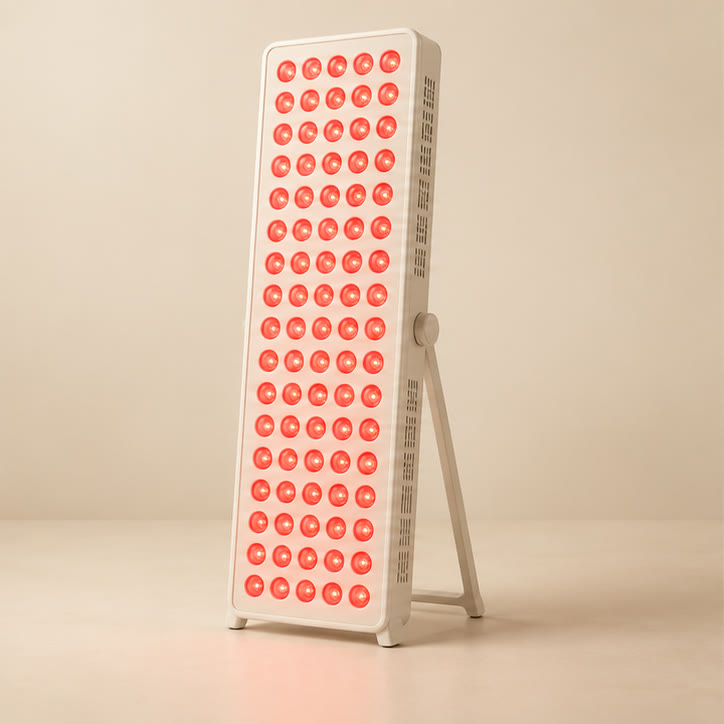
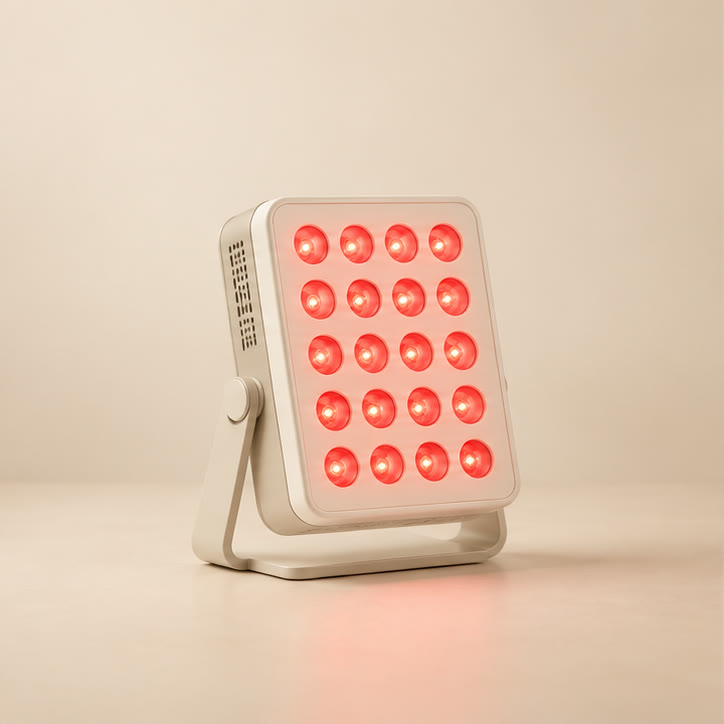
We sell red light devices, including the full-size Ritual Panel at £599, so it's worth being upfront: our device specifications aren't confirmed, and that includes which wavelengths they use. Nothing on this page describes our products. It's a plain explanation of the two kinds of light and what the research says, read on PubMed on 19 October 2026.
Red light vs near infrared: the basic difference
Light is described by its wavelength, measured in nanometres (nm). Visible light runs roughly from violet to red, and beyond red comes infrared, which you can't see.
A 2024 review for dermatologists in the Journal of the American Academy of Dermatology, by Mineroff and colleagues, defines the two bands used in this field as red light at 620 to 700 nm and near-infrared at 700 to 1,440 nm. A device listing will usually name specific wavelengths within those ranges rather than the whole band. The trials below, for example, used LEDs at 630, 660 and 850 nm.
So when a listing says a device uses red and near-infrared, it's telling you it has LEDs at a wavelength or two in each of those ranges. It isn't telling you how much light comes out, which is a separate question we deal with in our guide to reading device specifications.
You can see one and not the other
This is the practical difference you'll notice first. Red LEDs glow a deep red. Near-infrared sits beyond the range your eyes can see.
What is the difference between red light and near infrared?
Wavelength. A 2024 review in the Journal of the American Academy of Dermatology by Mineroff and colleagues defines red light as 620 to 700 nm and near-infrared as 700 to 1,440 nm. Red light is visible as a deep red glow. Near-infrared is beyond what the eye can see.
Does near infrared go deeper than red light?
In modelling, yes. Ash and colleagues (2017) used computer simulations of layered skin and found penetration depth increases with increasing wavelength. That is a model of how light travels through tissue, not proof that deeper light gives a better result.
Is red or near infrared better for skin?
There is no clear winner. In the 2014 Wunsch and Matuschka trial, a broader spectrum reaching into near-infrared showed no advantage over red light alone for skin appearance. Other trials, such as Park and colleagues in 2025, combined the two and also reported improvements.
Do you need both red and near infrared light?
The research doesn't show that you do. The 2026 systematic review by Das and colleagues found red and near-infrared were the most commonly used wavelengths in at-home face devices, but varied protocols and limited head-to-head data mean nobody can say a combination beats either alone.
What wavelengths do Redlume Ritual devices use?
We can't tell you yet. Our device specifications, including wavelengths, are not confirmed. We will publish them on the product pages once they are, along with the measurement conditions.
That has a safety consequence. With red light, you can at least see that something is on. With near-infrared, you can't judge it by eye at all. Which is one reason we'd never judge a device's output, or its safety, by how bright it looks. The international standard for photobiological safety of LEDs, IEC 62471, covers wavelengths from 200 nm to 3,000 nm, so both red and near-infrared fall within it. Ask whether a device has been assessed against it.
How deep each one goes
You'll often see near-infrared described as reaching deeper. There's a reasonable basis for that, with a big caveat.
Ash and colleagues (2017) used Monte Carlo computer modelling, a standard way of simulating how light scatters in skin, with a multi-layered skin model. They found that penetration depth increases with increasing wavelength, and calculated a maximum penetration depth of 5,378 micrometres, a little over 5 mm, across the wavelengths they modelled. They also looked at beam width and skin tone. A 10 mm beam delivered 73 to 88% of the light level, at depths of 1 to 3 mm, that an infinitely wide beam would, which the authors read as meaning larger spot sizes add little extra penetration.
The caveat is that this is a computer model. It tells you where light is likely to travel. It doesn't tell you what the light does when it gets there, or whether reaching deeper produces a better result for whatever you're hoping for. For the look of skin, which is what most home devices are used for, the target is the skin itself, so extra depth may not matter much at all.
What the light is thought to do
Both red and near-infrared are thought to work through the same broad mechanism, which is part of why they're often combined.
De Freitas and Hamblin (2016) reviewed the proposed mechanisms of what's now called photobiomodulation. They describe cytochrome c oxidase, part of the energy-producing machinery inside cells, as one of the most important light-absorbing molecules, and say it absorbs light into the near-infrared region. The leading hypothesis is that light frees the enzyme from nitric oxide that otherwise slows it down, leading to more energy production in the cell. They also describe a second hypothesis involving light-sensitive channels that let calcium into cells.
Note the word hypothesis. The mechanism is still being worked out. It's a plausible explanation for why both bands might do something, not proof that either does a particular thing in your skin.
What the trials compared
This is where it gets interesting, because the trial evidence doesn't line up neatly with the idea that deeper is better.
Red alone held its own
Wunsch and Matuschka (2014) ran a randomised controlled trial with 136 volunteers. Some were treated with red light only, at 611 to 650 nm. Others were treated with a broader spectrum running from 570 to 850 nm, reaching into near-infrared. Both groups improved on skin complexion, roughness and collagen density measures compared with controls after 30 sessions. But the authors concluded that the broadband light showed no advantage over the red-light-only spectrum.
That's one trial, but it's a direct comparison, which is rare in this field.
Combined light also showed results
Park and colleagues (2025) tested a home mask that combined 630 nm red LEDs with 850 nm near-infrared, against a sham mask, in 60 adults. The active mask did better for crow's feet at 8, 12 and 16 weeks. That tells you the combination can work in a trial. It doesn't tell you whether red alone would have done just as well, because that wasn't tested.
Red only, mixed results
Bragato and colleagues (2025) used a red-only mask at 660 nm in 95 women. There was no difference on a specialist wrinkle scale, though software measurements found shorter lines in some areas and satisfaction was higher than in the sham group. So red alone produced some effect, but not a strong one.
The review
Das and colleagues (2026) reviewed eight studies of at-home LED face devices with 365 participants. Wavelengths ranged from 440 to 1,072 nm, with red and near-infrared the most commonly used, and the authors found improvements in facial ageing measures particularly with those wavelengths. They also pointed to varied protocols and limited comparative data. In other words, the field hasn't done enough head-to-head work to say which wavelengths are best.
The amount of light matters as much as the colour
It's easy to get fixated on wavelength because it's a neat number. But a device at the ideal wavelength with too little output, or too much, may not do what you'd expect.
Huang and colleagues (2009) described a biphasic dose response in low-level light therapy, where low levels of light often have a better effect than higher levels. They also said that the number of settings to choose between, including wavelength, dose, power density, pulsing and timing, has led to negative studies as well as positive ones. That's a useful reminder that red light vs near infrared is one question among several, not the whole answer.
For you as a buyer, that means wavelength on its own doesn't tell you much. You also want measured output at a stated distance, the treatment time, and the manufacturer's reasoning for those settings.
Listing claims worth questioning
Because wavelength is easy to print on a box, it gets used as a selling point in ways the research doesn't support. A few we'd treat with care.
"More wavelengths is better." Some devices list five, seven or more wavelengths. In the Wunsch and Matuschka trial, a broad spectrum covering 570 to 850 nm did no better than red light alone for skin appearance. More colours on the spec sheet isn't evidence of more effect.
"Near-infrared reaches the muscles, so it's better." Modelling like the Ash study shows longer wavelengths travel deeper in a simulated skin. That's a fact about light, not a result for any part of the body. And if the use you have in mind is muscles or joints, that's a health claim we won't make.
"Clinically proven wavelengths." A trial proves something about a particular device at a particular dose in a particular group of people. It doesn't transfer to every product that uses a similar number. Ask which trial, and whether it used that device.
"You can feel it working." Some devices feel warm. Warmth isn't a measure of red or near-infrared output, and the research we read doesn't use it as one.
Why so many devices pair the two
The evidence for combining them is thin, so it's fair to wonder why so many devices do it. Part of the reason is the mechanism. De Freitas and Hamblin describe the main light-absorbing molecule as absorbing into the near-infrared region, so it's plausible both bands do something. Part is the trials: Das and colleagues found red and near-infrared were the most common wavelengths in the at-home studies they reviewed, so manufacturers can point to research using both. And part is marketing, because two bands sounds like more than one.
None of that is a reason to avoid a combined device. It's just a reason not to pay extra for one on the assumption that it must work better.
Which might suit what
We're cautious here, because the evidence doesn't support firm rules. But these are the fair things to say.
For the appearance of facial skin, red light alone has trial evidence behind it, and in the one direct comparison we found, adding near-infrared didn't help. Combined red and near-infrared devices have also shown results in trials.
For anything deeper than skin, like muscles or joints, people often point to near-infrared because of the modelling on penetration. We don't make claims for those uses, and if you have pain or a joint problem, a GP or physiotherapist is the right person to see.
For eyes, both bands need care, and near-infrared particularly because you can't see it. Follow the device's eye guidance every time.
Does the format change the answer
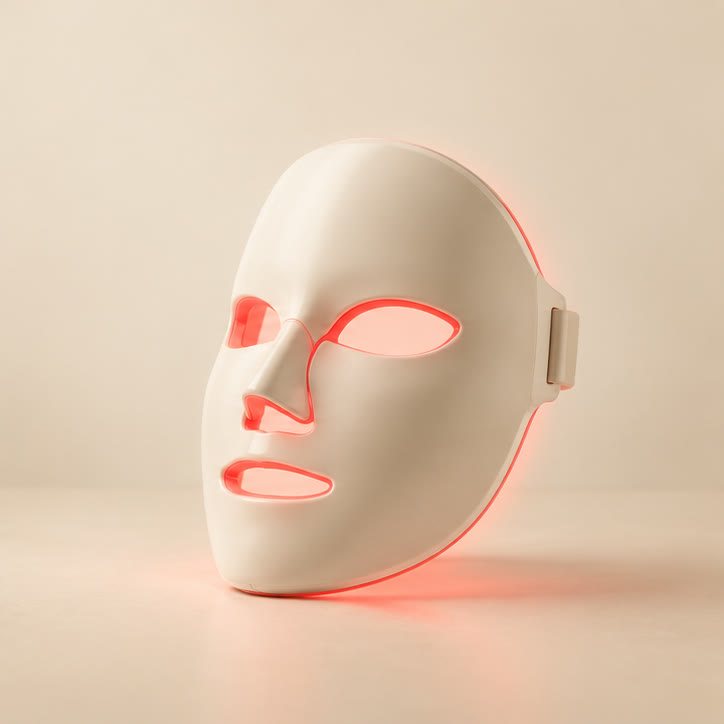
Not in any way the research has shown. Wunsch and Matuschka used large professional light units. Park and Bragato used masks. Both formats appear in trials with red only and with red plus near-infrared, so the choice between a panel and a mask isn't really a wavelength decision.
What the format does change is distance. A mask sits close to the skin, while a panel is used at a set distance that you control. Since the amount of light reaching your skin depends on distance as well as output, a panel's stated output only means something alongside the distance it was measured at. That's true whichever wavelengths it uses.
So we'd pick the format that suits where and how you want to use light, then check the wavelengths and measured output of the specific device, in that order.
Questions to ask about any device
When a listing mentions red, near-infrared or both, these are the questions we'd ask.
Which exact wavelengths are used, in nm, and how many LEDs of each?
What's the measured output for each, in what units, at what distance?
Can the red and near-infrared be used separately, or only together?
What session length does the manufacturer recommend, and why?
Has the device been assessed against IEC 62471?
If a seller can't answer, that's a reason to look elsewhere. Our guide to choosing between panels and masks covers the other practical questions, and our page on planning a routine covers how to fit whichever device you choose into your week.
Who this is not for
If you're hoping near-infrared will treat pain, an injury, inflammation or any medical condition, this isn't the right page or the right shop. We don't make medical claims, and a GP, pharmacist or physiotherapist can tell you what has proper evidence behind it.
If you take a medicine that makes you sensitive to light, have a light-sensitive condition, an eye condition or are pregnant, speak to your GP or pharmacist before using either kind of light.
Where this leaves our devices
We know some readers came here to find out which wavelengths the Ritual Mini, Ritual Panel and Ritual Mask use. We can't tell you yet, because those specifications aren't confirmed, and we're not going to guess. When they're final, they'll be published on each product page with the output and the conditions they were measured under, so you can compare them fairly against anything else.
Until then, here's the plain summary. Red light is visible, near-infrared isn't, and near-infrared is modelled to travel a little deeper. For the look of skin, red light on its own has held up in trials, and combinations have too. Neither has been shown to be clearly better, and the amount of light matters at least as much as its colour.