Red light therapy for skin: what the studies actually show | Redlume Ritual
Science
Red light therapy for skin: what the studies actually show
·11 min read
Red light therapy for skin is the reason most people first look at a mask or a panel. The short, honest version: a handful of small trials have found that red and near-infrared light may help skin look smoother and fine lines look softer, a few found little or nothing, and nobody has run the large, long trials that would settle it. It's a cosmetic question with a modest evidence base, not a medical treatment.
We're about to sell a mask, the Ritual Mask at £199, so you're entitled to be sceptical of anything we say here. That's why every study below has its name in the sentence and a link in the sources list. We read each abstract on PubMed on 19 October 2026. Where a result is weak we say so.
One more thing before the detail. Our own devices don't have published specifications yet: no confirmed wavelengths, no output figures, no trial data. So nothing on this page is a claim about what a Redlume Ritual product will do. It's a summary of what researchers found using their own equipment.
Does red light therapy for skin actually work?
Here's the plain answer. For the appearance of fine lines, roughness and how skin feels, there is some evidence from randomised, controlled trials that red light, sometimes combined with near-infrared, makes a measurable difference over a period of weeks. The trials are small, they use different devices and settings, and some of them are funded by or run alongside device makers. So it's fair to call the evidence promising but unproven.
What red light has not been shown to do is change your skin the way a prescription treatment or an in-clinic procedure might. And for anything that counts as a skin condition rather than a cosmetic concern, the picture is weaker still, which we come back to below.
The studies worth knowing about
The 2014 Wunsch and Matuschka trial
This is the study most often quoted, and it's a reasonable place to start. Wunsch and Matuschka (2014) recruited 136 volunteers. Of those, 113 were randomly assigned to one of four light groups and treated twice a week, with 23 people acting as controls. After 30 sessions the researchers looked at blinded photographs, measured skin roughness with a profiling instrument and measured collagen density with ultrasound.
For the look of fine lines and skin texture there is some encouraging trial evidence, but it is small and mixed. A 2014 controlled trial by Wunsch and Matuschka with 136 volunteers reported smoother-looking skin after 30 sessions, and a 2026 systematic review by Das and colleagues of eight at-home LED studies found improvements alongside a call for larger trials.
How long does red light therapy take to show results on skin?
In the trials we read, people used light for weeks, not days. The Park 2025 mask trial assessed crow's feet at 8, 12 and 16 weeks, and the Wunsch 2014 trial measured after 30 sessions at twice a week. Nobody should expect an overnight change.
Can red light therapy help acne?
We don't claim that. Acne is a medical condition, and the 2016 Cochrane review by Barbaric and colleagues found high-quality evidence on light therapies for acne is lacking. If you have acne, a GP or pharmacist is the right first stop.
Is red light therapy good for wrinkles?
Some trials say it may help wrinkles look softer, others found nothing. The 2025 Bragato trial found no difference on a specialist wrinkle scale but shorter measured lines between the brows and around one eye, while a 2024 trial by Garcia and colleagues found red light added nothing to dermal thickness.
Will a Redlume Ritual device improve my skin?
We can't say that, and we won't. Our devices have no published specifications or trials yet. The research on this page describes other devices used under study conditions, and it does not tell you what any one product will do for you.
The treated groups had better-rated complexion, smoother measured skin and higher collagen density readings than the controls. One detail is worth pausing on. The researchers compared a red-only light with a broader spectrum that also reached into near-infrared, and the broader light showed no advantage over red alone.
What it doesn't tell you: it's one trial, the control group was small, and the light sources were large professional units, not something you'd hang in a bathroom. It's a decent signal, not proof.
The 2025 Park mask trial
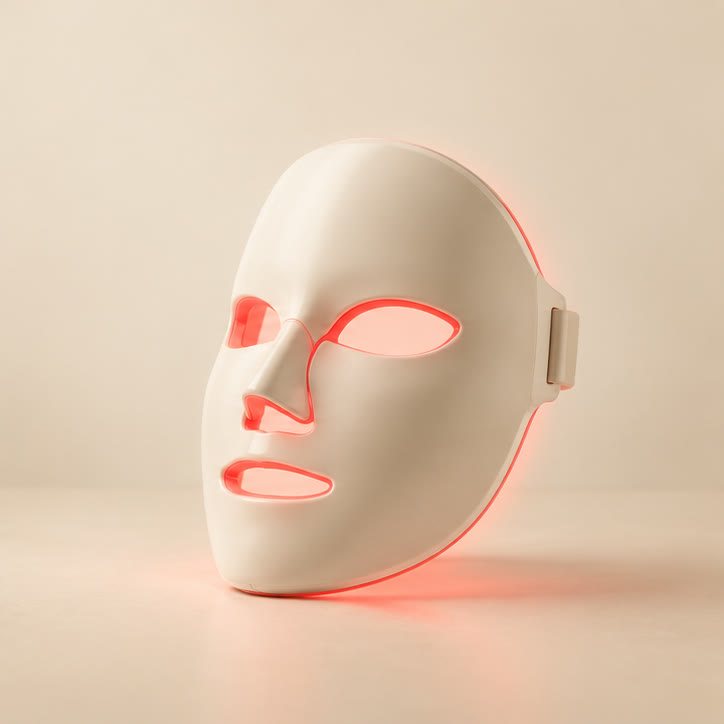
Park and colleagues (2025) tested a home-use mask in 60 adults aged 30 to 65, half using an active mask and half using a sham one that looked the same. Neither the participants nor the investigators knew who had which. The active mask combined red and near-infrared LEDs. The researchers scored crow's feet at 8, 12 and 16 weeks using a grading scale, rated by independent assessors as well as the study team.
The active group did better at every one of those checkpoints. That's a stronger design than many in this field because of the sham device and the blinding. It's still 60 people, all of Asian descent, in one country, with one device. So it tells you a well-designed mask can show an effect in a trial. It doesn't tell you every mask will.
The 2025 Bragato trial
This one is useful because the results were mixed, and mixed results are what real research usually looks like. Bragato and colleagues (2025) gave 95 women aged 45 to 60 a red LED mask, either three times a week or twice a week for four weeks, against a sham group.
On the main specialist wrinkle scale, there was no significant difference between any of the groups. On software measurements of the photographs, the lines between the brows and around one eye were shorter in the light groups. Satisfaction was high, at 79.6% and 73.4% in the two active groups, and that was significantly better than the sham group. Going three times a week rather than twice didn't add anything.
So: people liked the result, a computer measured some small changes, and the specialist raters didn't see enough to score a difference. That's an honest summary of where red light for skin sits.
A trial that found nothing
Garcia and colleagues (2024) added red light to a cosmetic thread-lift procedure in 40 people to see whether it thickened the skin further or helped with swelling. It didn't. The threads thickened the skin on their own and the light added no measurable effect at the settings used. Not every study is a win, and the ones that aren't still count.
What the reviews say when they pool the evidence
Single trials can mislead. Systematic reviews, which gather all the qualifying trials and judge them together, are a better guide.
Jagdeo and colleagues (2018) reviewed 31 randomised controlled trials of LEDs in dermatology. They were broadly positive about LEDs as a developing option and noted few adverse events, but they also listed the problems: small sample sizes, some under 20 people, missing blinding, no sham placebo in some trials, and treatment settings that varied from study to study. Several skin uses only reached their lower grades of recommendation.
The most recent review we found is Das and colleagues (2026), published this month. It looked only at at-home LED devices for the face and included eight studies with 365 participants in total. Across those studies, home LED use was linked with statistically significant improvements in wrinkles, texture and elasticity, plus high satisfaction, and side effects were infrequent, mild and short-lived. The authors also pointed to varied protocols, limited head-to-head data and too few people with darker skin types in the trials, and asked for larger, standardised studies.
Put those two reviews together and you get a fair picture. There's a consistent lean towards a small cosmetic benefit. The quality of the evidence is moderate at best. And skin of colour has been under-studied, which matters if you have deeper skin.
Skin conditions are a different question
People search for red light therapy for acne, rosacea, scars and eczema as well as for fine lines. We don't make claims for any of those, for two reasons.
The first is the evidence. Barbaric and colleagues (2016), in a Cochrane review, looked at 71 studies of light treatments for acne with 4,211 participants. Most studies were small, with a median of 31 people, and two thirds were industry-sponsored. Their conclusion was that high-quality evidence on light therapies for acne is lacking. That's not a ringing endorsement.
The second is the law. In the UK, a product that claims to treat or prevent a medical condition is presented as a medical device and needs to be registered with the MHRA. The Advertising Standards Authority made this point in November 2025, when it ruled against an LED mask advert that mentioned acne and rosacea; the ASA said the claims implied the product could treat medical conditions and the mask wasn't registered with the MHRA. We aren't selling a medical device, so we don't talk about conditions.
If you have acne, rosacea, eczema, psoriasis or any skin problem that's bothering you, please see a GP or a pharmacist first. They can offer treatments with far better evidence than anything on this page.
What the trials had in common
If you're going to try red light for the look of your skin, it helps to know what the studies that found something actually did. A few patterns come up again and again.
They ran for weeks. The shortest active period above was four weeks and the longest was 16. Many people give up after a fortnight because they've seen nothing, which is a bit like judging a moisturiser after two nights.
Sessions were regular but not daily in every case. Wunsch used twice a week. Bragato found two sessions a week did as well as three for satisfaction and photo measurements. Park's mask protocol ran for 16 weeks. The exact schedule for any device should come from its own instructions, and we cover that in our guide to planning a routine you'll keep.
They used specific, documented light. Each trial reported its wavelengths and measured output. A product that won't tell you those numbers is asking you to take a lot on trust, which is why we wrote a guide to reading device specifications before we wrote anything else. We'll hold ourselves to that same standard: when our final specifications are confirmed, they'll be published in full. Until then we won't put a number on our product pages.
Panels or a mask for skin
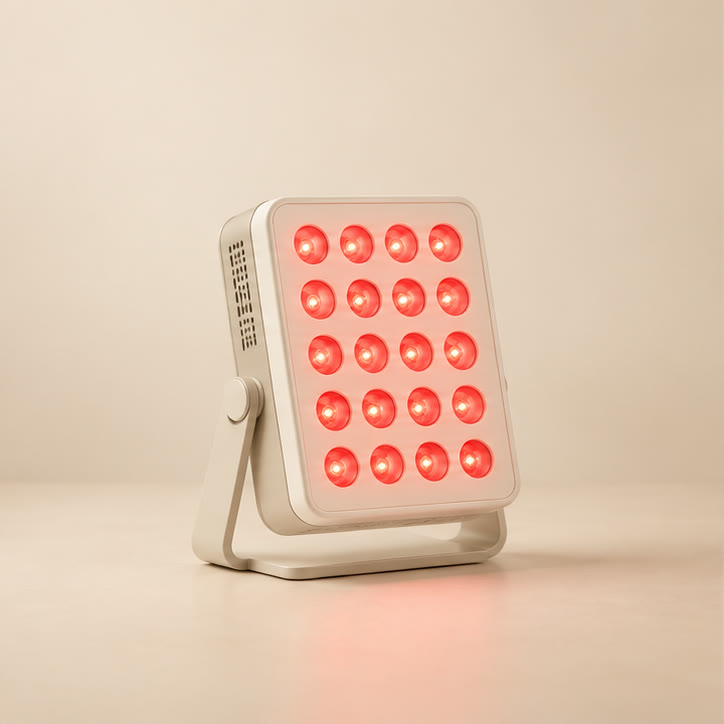
The trials above used both formats. Wunsch used large panel-style units and Park and Bragato used masks. Neither format has been shown to beat the other for the appearance of skin, and we don't think anyone can honestly say otherwise.
The practical differences are about you, not the light. A mask sits on the face and frees your hands. A compact panel like the Ritual Mini at £249 can be pointed at your face, neck or the backs of your hands, and you sit in front of it. Some people find a mask claustrophobic; others find sitting still in front of a panel boring. Our comparison of panels and masks goes through placement, storage and fit in more detail.
If you'd like both, The Starter Ritual puts the Mini and the Mask together for £429, against £448 bought separately. We're not saying two devices work better than one. Some people just like a mask for the face and a panel for everything else.
Who this is not for
Be honest with yourself about a few things before you buy anything for red light therapy for skin, from us or from anyone else.
It's not for treating a skin condition. If something on your skin is painful, spreading, bleeding, changing shape or colour, or just worrying you, that's a job for a GP.
It's not a substitute for sunscreen or for anything your GP or pharmacist has recommended.
It's not for you if you're on a medicine that makes skin sensitive to light, if you have a condition affected by light such as lupus, or if you're pregnant, unless your GP or pharmacist is happy for you to use it. The NHS page on lupus advises against spending a lot of time in rooms with fluorescent lights, and the NHS lists sun sensitivity as a side effect of the antibiotic doxycycline. Other medicines carry similar warnings in the leaflet, and a pharmacist can check yours in a couple of minutes.
And it's not for anyone who wants guaranteed results in a set time. No trial we read promised that, and we won't either.
How we'd approach it
If you asked us over a coffee whether red light therapy is worth trying for your skin, here's roughly what we'd say. The evidence is real but thin. The best-designed trial we found, Park's, used a sham mask and blinded assessors and still only had 60 people. If you go in expecting a subtle change in how your skin looks after a couple of months of regular use, you'll be judging it fairly. If you expect your face to look ten years younger, you'll be disappointed, and so would anyone reading the same studies.
Take a photo in the same light, at the same time of day, before you start. Take another every four weeks. That's more useful than trying to remember what your skin looked like.
Keep the rest of your routine steady while you try it. If you change your moisturiser, start a new serum and buy a mask in the same week, you'll never know which one made any difference.
And keep your receipts. When we launch, delivery is free and tracked on orders over £100, and you have the UK and EU 14-day right to cancel. That's a legal right, not a favour, and it gives you time to check the device and its documentation in person.
What we can't tell you yet
We can't tell you the wavelength, output or treatment time for the Ritual Mask or any of our devices, because those specifications aren't confirmed. We can't tell you what's in the box either. When those details are final and checked, they'll go on the product pages and in the manual. If a detail matters to your decision, wait until it's there. We'd rather lose a sale than have you buy on a guess.
What we can tell you is what the research says, without the gloss. Red light therapy for skin is a cosmetic option with some encouraging, small, mixed evidence behind it. That's not nothing. It just isn't the miracle some adverts make it sound like.